
How important is genetics in muscle building?

Is genetics decisive in muscle building?
If you train regularly, you can usually increase your muscle cross-section. But what adaptations can you expect? How important is genetics in muscle building?
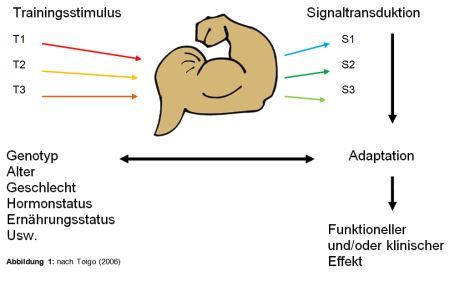
When a training stimulus is applied, this leads to a signal in the fatigued muscles. This signal then leads to an adaptation. These adaptations differ from person to person. The following factors influence the strength of the adaptation to the training stimulus: sex, age, hormone status, training status, nutritional status etc. (see figure)
How much muscle mass gain can I usually expect?
In 2005, Hubal et al. conducted a study. 585 subjects (243 women, 342 men) aged 18-40 trained their non-dominant arm with resistance training over 12 weeks. The upper arm muscle cross-section was measured, among other things.
After 12 weeks, the study produced the following results:
- On average, the men increased their muscle mass by 20%, the women by 18%. Within both groups, however, there were very large differences in muscle mass gain and muscle strength.
- 3% of the men and 2% of the women were able to build more than 30% muscle mass in the same time. These belonged to the so-called "High Responders". They react very well to resistance training.
- 1% of the men and women responded very poorly to resistance training. They either gained no muscle mass or even lost some muscle mass. These are called "Non-Responders". They react very poorly or not at all to resistance training in terms of muscle mass.
Genetics therefore plays an important role in muscle building. In terms of muscle mass gain, the genetic share is approx. 70%.
Adaptation to resistance training is therefore very individual, even if two people train in exactly the same way.
Copying training programmes or methods from "High Responders" therefore does not guarantee training success. Genetics partly determines your success.
The following points should be observed for maximum success in resistance training
Resistance trainingTry to generate as high a tension as possible in the muscle. High loads are not necessary for this and are sometimes counterproductive! The chosen resistance should be applied to the target muscle in as isolated a way as possible. The muscular load should therefore be as high as possible. Science has disproven that only high weights can build muscle. What matters is muscle fatigue. Perform the movement slowly and controlled until local muscle exhaustion (approx. 10 seconds per movement). Aim for a tension duration of approx. 60 – 100 seconds until complete exhaustion.
Multiple sets of the same exercise are not absolutely necessary. There is no proof that so-called "multi-set" training is superior to "single-set" training. What matters is total exhaustion within the tension duration of approx. 60 – 100 seconds. Therefore perform the exercise perfectly and make sure you do not release the resistance before complete muscle exhaustion. Perform several functionally different exercises for the same muscle (e.g. butterfly, chest press etc.).
Nutrition
For muscle mass gain, the protein net balance must be positive. You must therefore build more muscle than you break down. You can achieve this through regular resistance training and optimal protein dosing. Aim for a sufficient daily protein intake of approx. 1.3 to 1.7 g of protein per kilogram of body weight. Divide this amount into 20 g portions every 3 - 4 hours (4 - 6 times a day). Take one portion directly after your training in the form of whey protein.
In addition to protein dosing, pay attention to a balanced diet.
Recovery
Resistance training also stimulates muscle-breaking processes. Muscle mass gain therefore occurs during the recovery phase, not during training. The muscle building rate remains elevated for up to approx. 48-72 hours after a training session. Aim for an interval of approx. 48 hours before the next training of the same muscle.
Good luck putting this into practice!Sources:
- Hubal et al. (2005): Variability in muscle size and strength gain after unilateral resistance training. Med Sci Sports Exerc 37: 964–972.
- Toigo M. (2006): Training-relevant determinants of molecular and cellular skeletal muscle adaptation, Part 1: Introduction and length adaptation. Schweiz Z Sportmed Sporttraum 54: 101–106.
- Toigo M. (2006): Training-relevant determinants of molecular and cellular skeletal muscle adaptation, Part 2: Adaptation of cross-section and fibre type modules. Schweiz Z Sportmed Sporttraum 54: 121–132.
