
How to get rock-hard defined muscles!
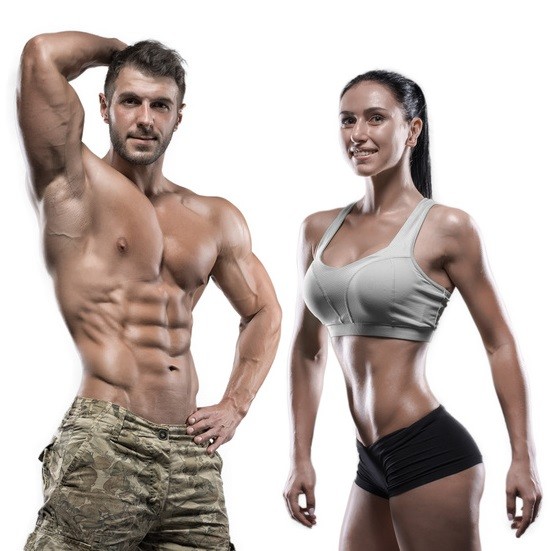
Defined Muscles. What Do I Need to Do?
Although it may seem a little strange at first glance: the basics for defined muscles are a local, percentage reduction of body fat and an increase in the local share of fat-free mass (muscle mass).
The recipe for rock-hard defined muscles is therefore no magic trick, but simply the reduction of fat mass (breakdown of body fat) combined with a simultaneous local increase in lean mass (building muscle mass). You will find out how to achieve this in the following article.
Building Muscle Mass
To build muscle mass as effectively and efficiently as possible, you should consider several parameters when training muscles. In summary, these are:
- anatomically correct exercise execution,
- movement through the greatest possible joint range of motion,
- a slow movement rhythm of roughly 3 s concentric – 2 s isometric – 3 s eccentric and 2 s isometric (so about 10 s per repetition),
- training until momentary muscle failure,
- a tension duration between 90 and 120 s,
- at least 48 h of recovery per muscle and
- intake of approx. 20 g of whey protein after training.
Put differently, choose a resistance for each exercise that fully fatigues the target muscles within 1.5 to 2 min at a slow movement speed, move through the full range of motion anatomically correctly, slowly and without momentum until you (really!) can no longer continue, and repeat the same procedure for the next exercise. For a full-body workout you need between 6 and 12 exercises and therefore a maximum of 30 min.
After finishing your training, consume around 20 g of whey protein and repeat the training after at least 2 and at most 4 days.
Reducing Fat Mass
You reduce fat mass when you achieve a negative energy balance over the long term. You can do this by either
1. consuming less energy while leaving your energy expenditure (resting energy expenditure plus energy used for activities such as training) unchanged (so eating less and moving just as much),
2. consuming the same amount of energy but increasing your energy expenditure at the same time (so training more without eating less) or
3. consuming less energy and also expending more (so eating less and training more at the same time).
You reach defined muscles fastest with option 3.
Without going into nutritional recommendations in detail, I recommend that you generally follow the guidelines of the Swiss Society for Nutrition and try to adjust your carbohydrate and fat intake to your needs. This will most likely mean you need to reduce your intake of starches, sugars and fat.
Muscle training as described above is also excellent for increasing your energy expenditure, because it firstly uses up a lot of energy in the moment and secondly, more muscle mass automatically leads to a higher resting energy expenditure. You should definitely supplement muscle training with targeted cardiovascular training. The best way to do this is to complete around 80% of your training time at a “easy” intensity (around 50-60% of max. oxygen uptake) and around 20% of the training time at “very intense” intensity (at around 80-90% of max. oxygen uptake). The Meta-Training from update Fitness is very well suited for this.
As an optimisation measure for cardiovascular training, I recommend that you do not eat a meal immediately before training, do not drink “sugar water” during training, and only eat your first carbohydrate-containing meal 3 hours after training. This may be easiest for you if you schedule your cardiovascular training early in the morning. If you do endurance training immediately after muscle training, it should be noted that this may inhibit muscle growth in the “endurance-trained” muscle.
Ideally, you train muscles and cardiovascular system on separate days.
You can increase fat loss by taking Sinetrol® daily, a natural active ingredient concentrate made from Mediterranean citrus fruits. Depending on the variant of Sinetrol®, you need 0.9-1.4 g per day.
Taking Sinetrol® led to a significant reduction in body fat after several months in various scientific studies!
Sources
- http://www.sge-ssn.ch/de/
- http://www.sfsn.ch/
- http://www.fytexia.com/
