
Are Deep Squats Harmful?
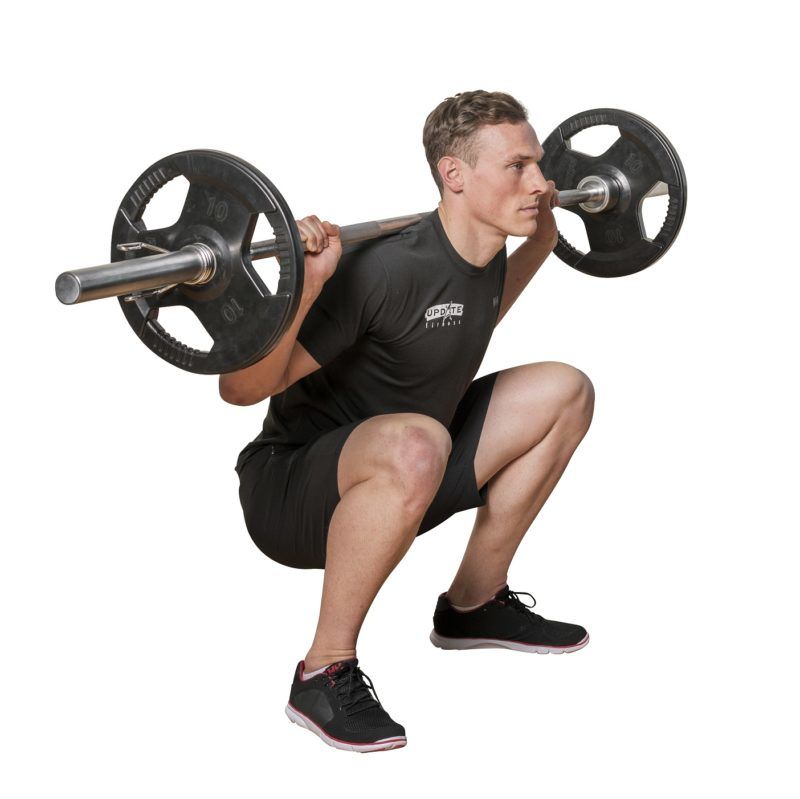
You often hear self-proclaimed experts claim that squats with an angle of less than 90 degrees between your shins and thighs are harmful. Is that really true?
As early as 1961, the first papers were published on the theory of the "deep squat" (e.g. "The deep squats exercise as utilized in weight training for athletes and its effects on the ligaments of the knee"). In this paper, Dr Klein argued that squats loosen the knee ligaments (especially the collateral and cruciate ligaments). He compared weightlifters with a control group.
Hard to believe, but young children – and people in many cultures around the world – often sit in a deep squat. This way of sitting can still be seen frequently in many African countries.
With shallow squats, the ligaments are exposed to greater strain, and the force acting on the ligaments decreases once you go past the 90-degree angle. (e.g. M. Sakane & colleagues, 1997; G. Li & colleagues 1999 and 2004; A. Kanamori & colleagues, 2000; K.L. Markolf & colleagues, 1996).
A 2001 study by R.F. Escamilla & colleagues found that weightlifters (who performed deep squats with heavy weights) had stronger knee ligaments than the control group.
Now let's turn to flexibility in the knee and hip joints. Flexibility is essential for preventing injuries. If limited flexibility means a squat can't be performed below a certain angle, there's a risk of serious injury. Let's say a footballer only ever squats down to a joint angle of around 100 degrees in his strength training. If he then has to make a lunge in a match situation that takes his joint below that 100-degree angle, the risk of injury will be very high, because he'll produce less force at that angle than if he had trained squats through the full range of knee motion.
This is due to the effect of regulating the number of sarcomeres in series – the adjustment of the optimal sarcomere length at which the muscle can produce its maximum force. As mentioned, if a muscle is trained through a shortened range of motion, the number of sarcomeres decreases. The remaining sarcomeres are then set to a length that offers optimal conditions for developing maximum strength in this now-shortened state (Williams and Goldspink 1978).
As a result, for a given muscle length, the average sarcomere length is shorter. In humans, training through the full range of motion shifts the optimal joint angle for generating maximum torque. This means the knee angle at which maximum torque can be generated also shifts (Toigo 2006).
In other words, after training, maximum torque is generated at a longer muscle length (in the case of squats, that means a deeper squat) – assuming the muscles involved have become longer. This means the muscle can then always be loaded through a shorter range during sport or everyday activities.
After an injury, you should start your exercises by improving joint flexibility. This is also why most physiotherapists recommend shallow squats to patients recovering from an injury.
Several studies have confirmed that people who regularly do deep squats have stronger ligaments. That actually makes sense: if deep squats really did lead to weak ligaments, weightlifters, for example, would fail at their sport (which is obviously not the case).
Conclusion
