
The Muscle
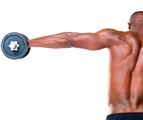
More than 600 muscles in the human body perform a huge range of tasks just to keep our body running at all. The heart pumps blood through the circulatory system non-stop, and the respiratory muscles let us breathe by ventilating our lungs. Muscles also make sure blood reaches the organs that need it, and that food doesn't get stuck in the gut but keeps moving along. Without muscles, our eyesight would be blurred. Without muscles, we couldn't speak.
Muscle tissue can be divided into striated muscle and smooth muscle. Smooth muscle can't be controlled voluntarily. The striated heart muscle can't be consciously controlled either. Striated skeletal muscle, on the other hand, we can actively control, letting us move around our environment and interact with it.
Three different types of contraction
An active muscle can only shorten, so as an agonist it's only ever responsible for part of a movement. It needs an opposing muscle (antagonist) for the movement in the other direction. Bending the arm, for example, is mainly down to the biceps brachii (the agonist). Its antagonist is the triceps brachii, which straightens the arm again. Muscle contraction relies on the building blocks of the muscle fibres: the actin and myosin filaments. When a muscle is activated, myosin binds to actin and slides along the actin filament. The two filaments are pulled into each other and the muscle tenses up. The muscle shortens and a movement is carried out (concentric contraction), as long as the resistance of an object (a dumbbell, say) is less than the force the muscle produces. If we hold an object up (a heavy shopping bag, for instance), the external resistance is equal to the muscle force, and the muscle does holding work (isometric contraction). When we sit down, the external resistance (our own body weight) is greater than the force produced by the thigh muscles (quadriceps femoris). The muscle slows the sitting movement down and stops us from dropping into the chair. Even though the muscle is producing force here, it's being stretched, so it's performing an eccentric contraction. It's eccentric contractions that are mainly responsible for the tiny injuries in the muscle that we then feel as muscle soreness a few hours after training. Walking and running also involve some eccentric contractions. These are especially pronounced going downhill (braking!) and are why muscle soreness can still remind you of a lovely hike days later.
Isometric contractions are especially important for stabilising the body (the spine). Without a well-stabilised core, every movement loses effectiveness. That's why, in strength training, it's crucial to train not just the muscle's concentric contraction but also its isometric and eccentric components. Skeletal muscle responds to training with an increase in its maximum strength. By forming additional actin and myosin filaments, skeletal muscle gains mass and can therefore generate more force. However, strength can also increase without a gain in mass, simply by learning to activate the muscle more effectively.
Controlling your body weight
During the individual reps of a strength training session, the muscle draws the energy it needs from creatine phosphate and carbohydrates. Overall, though, energy demand during strength training is fairly low. However, as muscle mass increases, so does your resting energy requirement. This is the energy your body needs for the functions of its organs (muscle included). That increased energy requirement can make it easier to control your body weight. Skeletal muscle isn't only trained through strength training, though; endurance activities also lead to adaptations in the muscle. An endurance activity involves many repeated muscle contractions that each generate a relatively small amount of force. This lets the muscle draw the energy it needs from fats and carbohydrates. Endurance training therefore does less to build muscle strength and more to improve the muscle's metabolism, so it can supply the energy needed during endurance training.
Strength training increases resting energy needs
So skeletal muscle isn't just fundamentally important for our movement, it also keeps us healthy! Strength training increases muscle mass and, with it, your resting energy requirement. Endurance activities can push that energy requirement up even further. That makes it easier to keep your energy balance even and to avoid building up little pockets of fat. Muscular activity also helps keep blood sugar levels on a healthy track, helping to prevent secondary conditions.
Expert opinion
What happens to your muscle if, for whatever reason, you can't train for a while? Does it get converted straight into fat? No! The fact is, though, that our body breaks down muscle that isn't regularly used. As a result, your resting energy requirement then drops too. And naturally, the extra energy demand created by strength or endurance training disappears as well. If you keep eating as much as you did during periods of higher physical activity, despite now being less active, you inevitably end up with a positive energy balance. A positive energy balance means your body has more energy available than it needs. It also means the body stores that surplus energy as fat, for times when less energy is available, for times of negative energy balance, times that, today, we very rarely encounter.
Sources: Dr Simon Annaheim, exercise scientist
