
Protein
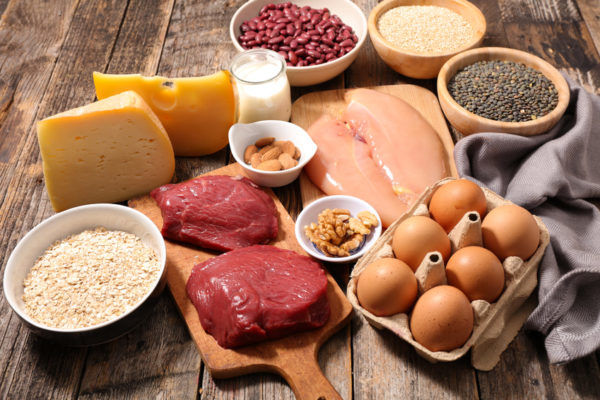
Proteins are protein substances that build and maintain muscles, organs and performance. In the body, proteins are used to build enzymes, hormones, muscles, connective tissue, skin, hair and nails. Because the body can only store protein to a very limited extent, new protein constantly needs to be supplied through food.
Amino acids are the basic building blocks of proteins. There are 20 different amino acids; certain amino acids cannot be produced by the body itself – these are known as essential amino acids. Amino acids the body can produce itself are the non-essential amino acids.
A "complete" protein contains all the essential amino acids. Not all amino acids occur in the same amounts.
Proteins can provide a small amount of energy, but this requires complex conversion processes. In extreme cases, proteins can protect against starvation via muscle breakdown (something that practically never happens at our latitudes). Protein also supports coordination and concentration.
How much protein do you need?
Athletes need around 1.2 – 1.6 g of protein per kg of body weight per day to build and maintain muscle. People who don't do any sport need 0.8 – 1.0 g of protein per kg of body weight per day. On rest days, it's recommended to take in 1.0 g of protein per kg of body weight, and 1.3 g per kg of body weight on training days.
The recommended daily amount can be obtained from natural food or with the help of protein concentrates. Protein concentrates offer the advantage of a low fat content, they have a low volume and don't contain the unwanted accompanying substances cholesterol and purine, which are often found in animal protein. This makes them suitable as a substitute after sporting activity. When using protein supplements, athletes should pay attention to the correct ratio of all essential amino acids.
The body can absorb a maximum of 20 g of protein per serving. It's therefore recommended to limit serving size to 20 – 25 g. To make up for this, eat enough meals to cover your daily requirement. The body can absorb protein every 3 hours.
Covering your daily ration
If you're struggling to cover your own daily dose, we recommend doing so with the 100% CFM Whey Isolate or Premium Whey Protein Concentrate protein powder from update Nutrition. Taking 100% CFM Whey Isolate optimises your protein supply in a natural way. This ensures that you don't break down any muscle mass during training.
After training
After training, around 20 grams of protein should be taken immediately. With the 100% CFM Whey Isolate protein shake from update Nutrition, the amino acids are available to the muscle fastest. More than 20 grams isn't recommended, as the body can't process any more at once – you'd only gain weight from it.
The 100% CFM Whey Isolate protein shake contains the optimal combination of proteins needed after strength training (also after endurance training) to optimally nourish the muscles and replenish the substances that were lost. The 100% CFM Whey Isolate contains enriched essential amino acids that boost muscle building and recovery. This means there's no need to combine a protein shake with an amino acid ampoule.
Strength training gives the muscle stimuli for muscle growth. However, this growth can only happen when there is a positive protein balance.
Directly after training, blood flow to the muscle is at its strongest, and within the first 30 minutes the muscle's capacity to absorb protein is greatly increased. The 100% CFM Whey Isolate can already be detected in the blood after just 15 minutes. This means the phase of increased muscle absorption capacity can be optimally supported.
