
Nutrition plan for muscle building – what does it do for me?
What does a nutrition plan for muscle building do for me
At some point in your training you get to the stage where you hardly build any muscle mass anymore. You stick to your training plan, push your workout to the end, always train to your limit and even pay attention to the recovery phases - yet your physical progress seems to stand still. This is where an adjusted nutrition plan for muscle building can help you. The right diet is crucial for building muscle.
A nutrition plan for muscle building makes sense.
Actually, you should only start building muscle through training once you have already adjusted your diet. Because training alone is not enough. Going to the gym is not enough to build muscle quickly, healthily and sustainably. Did you know that training itself only accounts for about 20 to 30 % of muscle building and the rest comes from nutrition? It is important not only that you eat the right things, but also that you eat the right amount. But beyond the "what" and the "how much", it is also important that the nutrition plan for muscle building fits your life. A standard plan from the internet makes no sense, because your body reacts very individually to nutrients and nutrient amounts. So you won't be able to avoid putting together an individual nutrition plan for muscle building.
Keep these points in mind:
- How often do you train per week?
- What is your starting weight?
- How trained are you already?
- Are you rather slim-built or are you already carrying some muscle mass?
Create your individual nutrition plan for muscle building based on your training experience. Here you will get a guide on how best to approach this.
Calorie requirements: how high is yours actually?
If you want to build muscle in the long term, you need a balanced calorie balance. In the short term, a gain in muscle mass is also possible with a negative calorie balance.
How much do you burn daily? Use one of the many online calculators to determine your calorie requirement. Once you know it, you should add about 100 to 200 extra calories. How many exactly you add depends on how hard you train and whether you are willing to accept new fat mass. What, fat? Right. Because no matter what your nutrition plan for muscle building looks like: you will never build pure muscle mass if you have a calorie surplus! The body always also puts on a certain amount of fat. However, you can keep it low by training hard and, if possible, having a balanced calorie balance.
Summary: About 100 - 200 extra calories is completely sufficient for the nutrition plan for muscle building.
Without protein it doesn't work
Protein is the most important nutrient in the nutrition plan for muscle building. That's why these little things should definitely become your best friends. Because muscles, skin, bones and connective tissue, even hair and the rest of your body consist of proteins. They are built a little differently everywhere, but they are still proteins. You make it easier for your body to build new muscle mass when you provide it with sufficient protein through your nutrition plan for muscle building. By the way, you also need protein to produce enzymes and hormones. Right, testosterone, which you also need for muscle building, is a hormone. Without protein your body cannot produce it.
Something else you should know: if your body gets enough calories but few of them in the form of protein, it will eventually break down muscle mass. Proteins are then released from the muscle to supply the remaining organs with protein. The excess calories are stored as fat in this case. Sounds awful, and it is.
Summary: Protein belongs in the nutrition plan for muscle building in the optimal amount. About 20 g per serving every 3 - 4 hours is sufficient.
Amino acids are what matter
Proteins consist of differently linked amino acids. For muscle building, it is important which amino acids you take in and in what quantity. So with your nutrition plan for muscle building it comes down to the right mix of different amino acids. There are 23 different amino acids, of which nine are essential. Essential means that your body cannot produce them itself and must get them through food. The remaining 14 amino acids can only be produced by the body when the essential ones are sufficiently available.
Curious? These are the candidates that must definitely be included in the nutrition plan for muscle building, or rather in the foods you put on your nutrition plan for muscle building:
- Histidine
- Isoleucine
- Leucine
- Lysine
- Methionine
- Phenylalanine
- Threonine
- Tryptophan
- Valine
You will find these amino acids not only in various foods on your nutrition plan for muscle building, but also in protein powders. Practically every muscle-building product and most protein powders contain exactly this mix.
You can picture proteins like a pearl necklace: the necklace consists of individual pearls strung together. Now imagine that each pearl is an amino acid. The different amino acids can be thought of as pearls of different shape and colour. All together they form a chain - proteins are long-chain molecules. You need 100 or more pearls to make one protein molecule. But there are also proteins with several thousand, because there is no upper limit. To cover all of this, you should make your nutrition plan for muscle building as varied as possible.
Summary: Your nutrition plan for muscle building must contain high-quality protein sources. These include, for example, meat (chicken breast, beef etc.), tuna, fish, low-fat quark, cottage cheese etc.
Don't forget carbohydrates!
Carbohydrates are cut down or removed entirely from many nutrition plans because they cause high insulin release. With your nutrition plan for muscle building this is not the case, you need carbs in it. Because you need insulin in the body so that nutrients are transported to the muscles more quickly. Carbohydrates, also called carbs, are the fuel for your muscles. They make sure you always have enough power in training and can really go all out. Without training, your muscles will not grow even with plenty of protein! Furthermore, you need carbs for the recovery of your muscles.
What you need are complex carbohydrates. You will find them in potatoes, fruit and vegetables, in all kinds of wholegrain products, in oatmeal and more. These give you long-lasting energy. Because, unlike white flour products or soft drinks, they do not make your blood sugar level go on a roller coaster. You should get about half of your calories from carbohydrates.
Summary: Make sure to include enough fruit, vegetables and wholegrain cereal products in your nutrition plan for muscle building.
What about fat?
Fat is the third macronutrient, and you also need fat for muscle building. Because without fat your body cannot produce hormones. You especially need testosterone for muscle building.
Be selective when you put fat on your nutrition plan for muscle building: monounsaturated and polyunsaturated fatty acids are an absolute must.
Summary: Avocados, nuts, mackerel, salmon etc. must be on your nutrition plan for muscle building.
Water is the most important thing
For healthy nutrition it is important that you drink enough water, spread throughout the day. Write your two litres of water on your nutrition plan for muscle building (at mealtimes) so you don't forget them.
The summary: all of this must be on your nutrition plan for muscle building!
- 30 to 35 % of your calorie intake is protein (approx. 20 g every 3 - 4 hours)
- 50 to 55 % of your calorie intake consists of complex carbohydrates
- 15 to 20 % of your calorie intake comes from healthy fats
- drink at least 2 litres of water daily
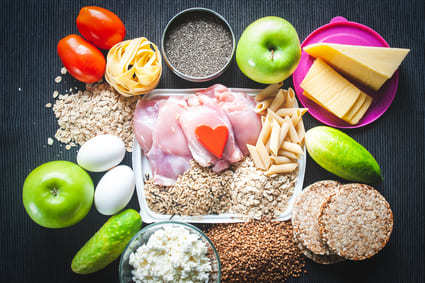
Your nutrition plan for muscle building ideally includes natural, unprocessed foods. Because they supply your body in the best possible way with vitamins, nutrients and minerals. The following foods could therefore be on your nutrition plan for muscle building: meat (chicken, beef etc.), fish, potatoes, oatmeal, low-fat quark, eggs, legumes. Spread the foods over many small meals throughout the day and supplement your protein intake with high-quality protein shakes or bars.
We wish you lots of success!
