
Eat as much protein as possible for muscle growth? Yeah, right!
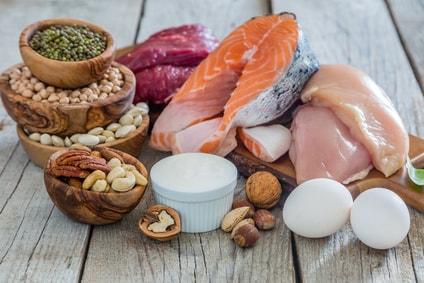
Eat as much protein as possible for muscle building? Have you heard that too?
If you want to build as much muscle as possible, you can never eat enough protein per day. You hear this again and again from some "fitness experts".
However, numerous studies have disproven this myth. But how much protein do you actually need for muscle building?
You often hear that protein requirements for athletes range from 0.8 g to 2.0 g per kg of body weight. This figure is not completely wrong, but it is unfortunately very imprecise. It says nothing about when this amount should be consumed. Unfortunately, a person weighing 75 kg could simply take 125 g of protein right after getting up in the morning and think they had consumed enough protein for the whole day. Your muscle protein synthesis rate fluctuates in a rhythm of 3 to 5 hours. The rate rises to a certain maximum and then falls back to its baseline level, every 3 to 5 hours. That is why you should split your protein intake into individual portions.
The amount of protein you should consume to maximally stimulate muscle-building processes depends heavily on your muscle mass. As a rule, men should take in about 0.25 g of protein per kg of body weight per portion. For women it is slightly less, at 0.23 g per kg of body weight per portion. The lower value for women comes from their on-average lower muscle mass.
Around 1.5 g to 1.7 g of protein per kg of body mass, spread across 5 to 6 portions, seems to be a good approach for the amount of protein needed for muscle building. You can easily reach this amount with a varied diet or supplement it with protein powder.
A higher protein intake does not lead to more muscle growth. Excess protein is used as an energy source or excreted in the urine. So be sure to pay close attention to the portion size of protein for muscle building
If you don't want to do the math, I recommend taking in about 20 g of high-quality protein every 3 to 4 hours for muscle building.
If you can't reach this amount through your diet, you can simply supplement your protein dosage with a high-quality protein powder.
Source: Atherton PJ, Smith K. Muscle protein synthesis in response to nutrition and exercise. J Physiol 590:1049–57, 2012.
