
Why you should pay attention to getting enough protein in old age!
Why you should pay attention to getting enough protein in old age!
The human body is made up of many different building blocks. A large part of it is water. Right behind that comes protein, often also called protein in German as Eiweiss. Adequate intake is therefore important for a healthy body. Especially in old age, however, it is difficult to meet the requirement. With the help of protein powder and plenty of exercise, the body can be kept fit even in old age.
What is protein?
The term protein is usually not familiar to many people. Yet behind it lies one of the most important building blocks for the human organism at all. Proteins are egg whites that consist of a large number of amino acids and perform different functions. For example, hair as well as the skin consist largely of proteins. Proteins, however, have another function that is at least as important. They are an essential component of the musculature. They primarily act both in building up muscle mass and in regenerative processes as well as in maintaining the musculature.
For this reason, protein is especially important in old age
With increasing age, food intake decreases for many people. This is usually due to the fact that they move less and therefore need to take in less energy for everyday life. The problem is that some important nutrients fall short as a result. Especially with regard to muscle mass, the intake of leucine and proteins suffers. Studies show that almost half of all older people are affected by an undersupply of corresponding macronutrients. Especially the valuable protein falls short. As a result, the musculature degenerates and age-related complaints then increase. If regular food intake can no longer satisfy the requirement, protein powder can help and provide sufficient protein.
Another aspect to consider is the effect of protein on bone structure. Scientists have found that proteins are also important for the growth and maintenance of bones. Up to an age of about 35 years, bone mass reaches its maximum value. Afterwards it begins to decrease. Protein intake is also particularly important to counteract this process. Accordingly, in cases of malnutrition, it is also helpful for bone strength to take in protein in the form of protein powder when needed.
Securing intake with protein powder
You can easily supply your body with part of the proteins it needs in daily life through regular food. However, there are various factors that contribute to this intake not being sufficient. On the one hand, the requirement increases with physical activity, and on the other hand, the ability to absorb nutrients drops significantly in old age. To still be able to regulate the protein balance, you can resort to protein powder. These are special concentrates made from high-quality proteins that serve as dietary supplements. As a rule, protein powder is taken as a shake for better and more effective absorption.
Another factor in ensuring sufficient protein intake through protein powder is the leucine it contains. Leucine is an essential amino acid that cannot be produced by the human body. It is all the more important that leucine is supplied alongside protein. This is primarily because leucine is actively involved in building new tissue structures and promotes protein metabolism in the musculature. At the same time, leucine helps inhibit the breakdown of muscle tissue and promotes regeneration processes.
What should you look for when buying protein powder?
When buying protein powder, you should check whether leucine is actually contained and, if so, in what quantity. Not all products contain this ingredient in sufficient amounts, even though proteins themselves basically consist of amino acids such as leucine. This is not problematic in itself, since the requirement can be covered by further dietary supplements in the form of amino acids, but this factor should always be considered. Without sufficient leucine, a large part of the effect of the protein is lost.
To recognise a good protein powder, you can make use of the ingredient list. By law, this must state all ingredients in descending order according to their percentage share. Accordingly, when buying protein powder, you should make sure that, alongside plenty of protein, leucine is also contained in the protein powder. In addition, a good and high-quality protein powder is characterised by a list of ingredients that is as short as possible. The longer the list, the more you should steer clear of such a protein powder.
How high is the protein requirement in old age?
The protein requirement is strongly debated even among experts. Not infrequently with differing results. Nevertheless, it can be roughly established how much protein should be consumed per day to meet the requirement. Without regular sporting activity, it is currently assumed that an adult should consume about 0.8 g of protein per kilogram of body weight per day. For older people, on the other hand, it is advisable to increase intake to 1.0 g to 1.2 g in order to really be able to ensure the requirement is met.
Dosage and intake of protein powder
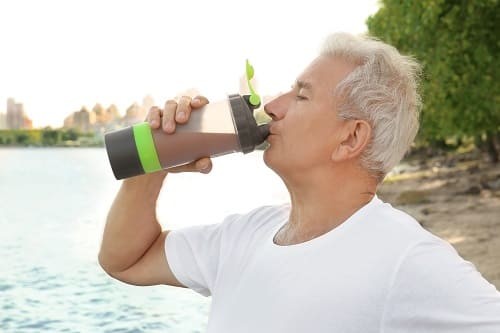
Anyone who decides to meet their protein requirement through protein powder should consider a few factors regarding dosage and timing of intake. Since in the end it is about strengthening muscle building and preventing the deterioration of the musculature, a controlled intake is advantageous. To provide sufficient protein for the daily requirement, protein powder can already be taken at breakfast in the form of a protein shake.
This way, the body has sufficient protein available to strengthen the musculature during daily activities. In addition, intake with dinner or shortly before going to sleep is recommended. This is also important, as the body goes through a multitude of regeneration processes during the night's rest. This includes the regeneration of the musculature, which cannot take place without proteins. Accordingly, the nightly requirement should also be covered by protein powder in cases of malnutrition.
Regarding dosage, depending on body weight, approx.
40 grams of protein powder should be taken per meal. This is usually a sufficient amount to maximally increase the rate of muscle building in old age. If you still do sports actively in old age, you can take an additional portion of protein powder before exercising in order to provide sufficient protein and leucine for muscle building.
