
Why should movement speed in a strength exercise generally be slow?

There are several reasons for this. On the one hand, swinging, “explosive” movements come with a drastically higher risk of injury. On the other hand, once the training resistance is accelerated at the start of the movement, it keeps moving forward in a straight line at a constant speed (see Figure 1 and Figure 2).
This momentum in the training resistance means a lower relative force output from the muscle. That, in turn, leads to a temporary derecruitment of motor units and so to a drop in tension in the muscle fibres of those derecruited motor units. The length of time the muscle fibres stay under tension until complete exhaustion is, however, a key criterion for muscle hypertrophy. According to A. V. Hill's well-known force–velocity relationship (see the blog post on the force–velocity relationship), muscle force decreases hyperbolically as the muscle's shortening speed increases.
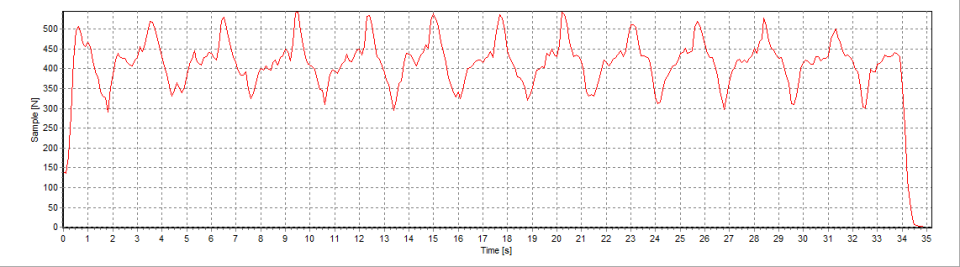
Figure 1: Behaviour of the training resistance at a movement speed of 2-2 (concentric approx. 2 sec and eccentric approx. 2 sec)
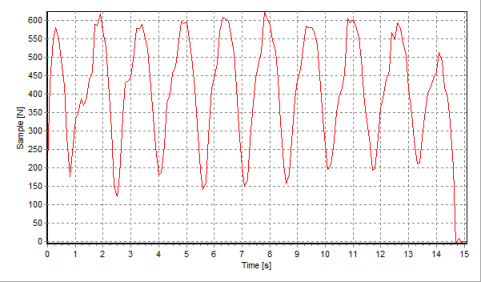
Figure 2: Behaviour of the training resistance at a movement speed of 1-1 (concentric approx. 1 sec and eccentric approx. 1 sec)
As the charts (Figure 1 and Figure 2) show, the training weight moves under its own momentum to a certain degree. This momentum in the training resistance again means a lower relative force output is needed to move the training weight. A reduction in force output can mean a derecruitment of motor units. When motor units, and therefore muscle fibres, are switched off, they're fatigued considerably less. If you want to train your muscles, you need to sap their strength and fatigue them as much as possible. Try it out, you'll feel the difference!
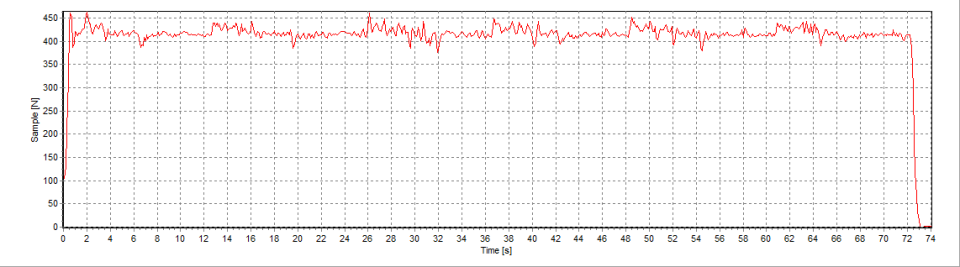
Figure 3: Behaviour of the training resistance at a movement speed of 3-2-3-2 (concentric 3 sec / isometric shortened 2 sec / eccentric 3 sec / isometric stretched 2 sec)
If the training weight is moved at a speed of 3-2-3-2 (see the blog post on the basic training variant), the fluctuations in the training weight are small. The relative force output stays constant. The 2-second loading time in the isometric stretched position is also important for triggering the lengthening adaptation (sarcomeres in series). Let's assume the weight is moved 6 times at a speed of 3-2-3-2; the training resistance is then also held for 2 seconds in the isometric stretched position 6 times. That adds up to a total time under tension of around 12 sec in the isometric stretched position. This time under tension should be enough to trigger the lengthening adaptation.
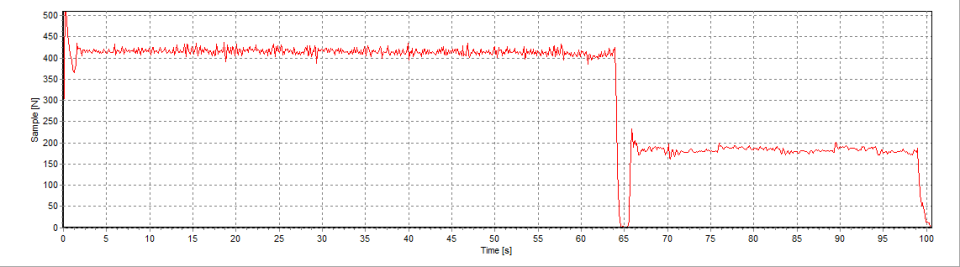
Figure 4: Behaviour of the training resistance with the Iso Contraction training method (approx. 60 sec isometric (static) shortened, followed by concentric 3 sec / isometric shortened 2 sec / eccentric 3 sec / isometric stretched 2 sec at around 50% of the training resistance)
If the training weight is held without movement in the maximally shortened position (see the blog post on the Iso Contraction training variant), there's hardly any fluctuation in the training weight and the relative force output stays constant. The training weight also acts on the muscle at the same intensity throughout the entire time under tension, since there's no change in the joint angle and therefore no change in the load on the muscle. The muscle can't produce the same muscular torque at every joint angle (see the blog post on the force–length relationship and Figure 5). This is also why, for example, during bicep curls, after a few reps the training weight can no longer be moved past the 90-degree joint angle (sticky points). Because of the leverage involved, the resistance is greatest at this joint angle. However, the muscle can't develop maximum force at this angle (see Figure 5). Depending on the muscle length, different amounts of force can be generated, or, depending on the joint angle, different amounts of torque can be produced.
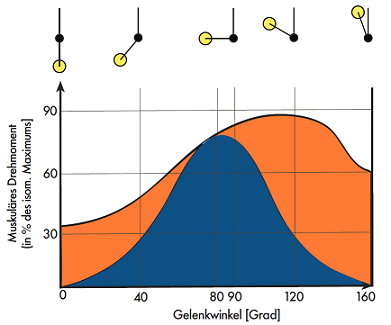
Figure 5: Muscular torque as a function of the joint angle
Isometric muscle contractions also increasingly restrict the energy supply, since blood flow to the muscle is reduced by the pressure on the blood vessels and comes to a complete stop at around 70% of maximum muscle force.
Reducing the training resistance afterwards fatigues the muscle even further, since the torque needed to produce a movement decreases. This means further reps can be performed.
We therefore recommend performing the exercise slowly and under control, decelerating at the turning points. Each exercise should be performed through to muscle failure (the point where an anatomically correct movement through the full range of joint motion is no longer possible). The time under tension should also be around 60–100 seconds.
Sources: update Fitness AG training philosophy, interview with Dr. sc. nat. Marco Toigo (Coach Magazin, issue 7), ZFASS, Forum of Applied Sport Sciences 2011
