The metabolism. We show you how it works.

The metabolism. We'll show you how it works.
Good metabolism, bad metabolism, a metabolism that's "asleep", kick-starting the metabolism, boosting it, ... The word metabolism gets used a lot, and unfortunately it's often misunderstood, too. Metabolism isn't the same thing as digestion.
The metabolism. What's it actually about.
Regardless of whether it's nerve cells transmitting electrical impulses or muscle cells doing mechanical work, every cell in the human body needs energy. This energy is stored within cells in the form of adenosine triphosphate (ATP) and is released when ATP breaks down
into adenosine diphosphate (ADP) and free phosphate (Pi).
ATP + water (H2O) -> ADP + P + energy
Since only a very limited supply of ATP is stored in the muscles, a constant supply has to be replenished by regenerating ATP from ADP and Pi. This regeneration happens via 3 different systems, which are matched in how they're expressed to the properties of the muscle fibres, the muscle fibre type. The
systems are:
- the phosphagen system (highest metabolic power, but lowest capacity)
- the glycolytic system (lower metabolic power, but higher capacity than the phosphagen system)
- mitochondrial respiration (lowest metabolic power, but by far the greatest capacity)
The phosphagen system
ATP resynthesis via the phosphagen system takes place in the cell plasma and comprises two chemical reactions through which the muscle fibre can recover ATP relatively quickly: the creatine kinase and the adenylate kinase reaction. 85% of the system's already modest capacity is covered by the phosphocreatine store
, while the remaining 15% comes from energy generated via the adenylate kinase reaction. Besides ATP, by-products are always produced too. The phosphagen system doesn't produce lactate, which is why it's also called anaerobic-alactic.
In the creatine kinase reaction -> ADP + PCr -> ATP and creatine (Cr)
Adenylate kinase (enzyme) -> 2 ADP -> ATP and AMP (adenosine monophosphate)
The metabolism works like a hybrid engine
When it comes to energy supply, we also talk about a hybrid engine, because each energy system sets another system in motion. For example, adenosine monophosphate and its breakdown products (from adenylate kinase) act as a signalling molecule for the cell. In other words, AMP tells the body that the muscle cells need glucose
(a simple sugar) and fatty acids to produce ATP. This stimulates the glycolytic system and mitochondrial respiration. It also indirectly stimulates the breakdown of glycogen (the storage form of sugar in the body). Because the phosphagen system is supported by the other two systems right from the start, it can make a significant contribution to energy supply for more than 20 seconds.
Left to its own devices, the PCr stores would already be exhausted after 10 seconds. The phosphagen system supplies us with energy very quickly for short bursts of movement, for example when we get up from a chair or have to sprint for a bus. But it's also exhausted very quickly. The phosphagen system is more pronounced in type II muscle fibres than in type I
muscle fibres.
The glycolytic system
The glycolytic system comprises the biochemical process of glycolysis. Like the processes of the phosphagen system, this takes place in the cell plasma. In this process, glucose or glycogen is converted into pyruvate over 10 steps. Glycogen is a complex sugar, or stored carbohydrate, in the muscles. In the liver,
for example, around 100 g can be stored, and around 400 g in the skeletal muscles. Pyruvate is an intermediate product. A great deal of energy is already released during the conversion of glucose to pyruvate. Two energy systems are available to pyruvate: anaerobic and aerobic glycolysis.
Which system is chosen depends on demand.
- Pyruvate can be converted into lactate and ATP in the cell plasma. This is known as anaerobic glycolysis (anaerobic-lactic). Not because no oxygen is present, but because this reaction doesn't require any oxygen. Some of our organs love using lactate as a starting material for metabolic processes. The liver and kidneys, for example, convert lactate into sugar via gluconeogenesis. Our heart even prefers lactate as an energy source. So, contrary to popular belief, lactate isn't a waste product of anaerobic metabolism. It always passes into the blood in combination with a proton (H+) via specific transporters from the glycolytic muscle cell (type II). The following example shows just how sophisticated a system lactate is part of:
The glycolytic muscle fibres (type IIb, with few or no mitochondria) produce lactate and release it into the blood. The oxidative muscle fibres (type I, with a great many mitochondria) then take up the lactate, convert it back into pyruvate and oxidise it in the mitochondrion.
Glucose -> pyruvate (intermediate product) -> 2 ATP + lactate - If the pyruvate isn't converted into lactate, it passes into the mitochondrion and is converted into acetyl-CoA. Acetyl-CoA is the starting material for aerobic energy supply in the mitochondrion. This is why, in this case, we talk about aerobic glycolysis ("using oxygen", not "in the
presence of oxygen"). Acetyl-CoA is fed into the citric acid cycle, where, with the addition of oxygen, it's processed into many ATPs.
Glucose + oxygen (O2) -> carbon dioxide (CO2) + water (H2O) + lots of ATP
Mitochondrial respiration
Fatty acids pass from the blood into the muscle fibres via fatty acid transporters, with type I muscle fibres better equipped with these transporters than type II muscle fibres. In the cell plasma of the muscle fibres, the fatty acids are activated and then transported into the mitochondria. For this purpose, they're
briefly bound to carnitine. Carnitine therefore acts as a shuttle in fat metabolism. Without carnitine, no fat could be metabolised. As the name suggests, mitochondrial respiration takes place under the influence of oxygen inside the mitochondrion. Inside the mitochondria, the
fatty acids are converted into acetyl-CoA via β-oxidation (the breakdown process for fatty acids). Just like the acetyl-CoA from pyruvate, this is broken down in the citric acid cycle into carbon dioxide (CO2) and water (H2O). This releases energy in the form of ATP. Mitochondrial oxygen consumption determines the body's oxygen requirement.
Fatty acids + oxygen (O2)- > carbon dioxide (CO2) + water (H2O) + a great many ATP
The metabolism shown schematically.
The following diagram illustrates the metabolism. Integration of the systems for energy supply: creatine kinase/phosphocreatine, phosphagen system (here
without adenylate kinase); anaerobic glycolysis, glycolytic system; oxidative phosphorylation, mitochondrial respiration.
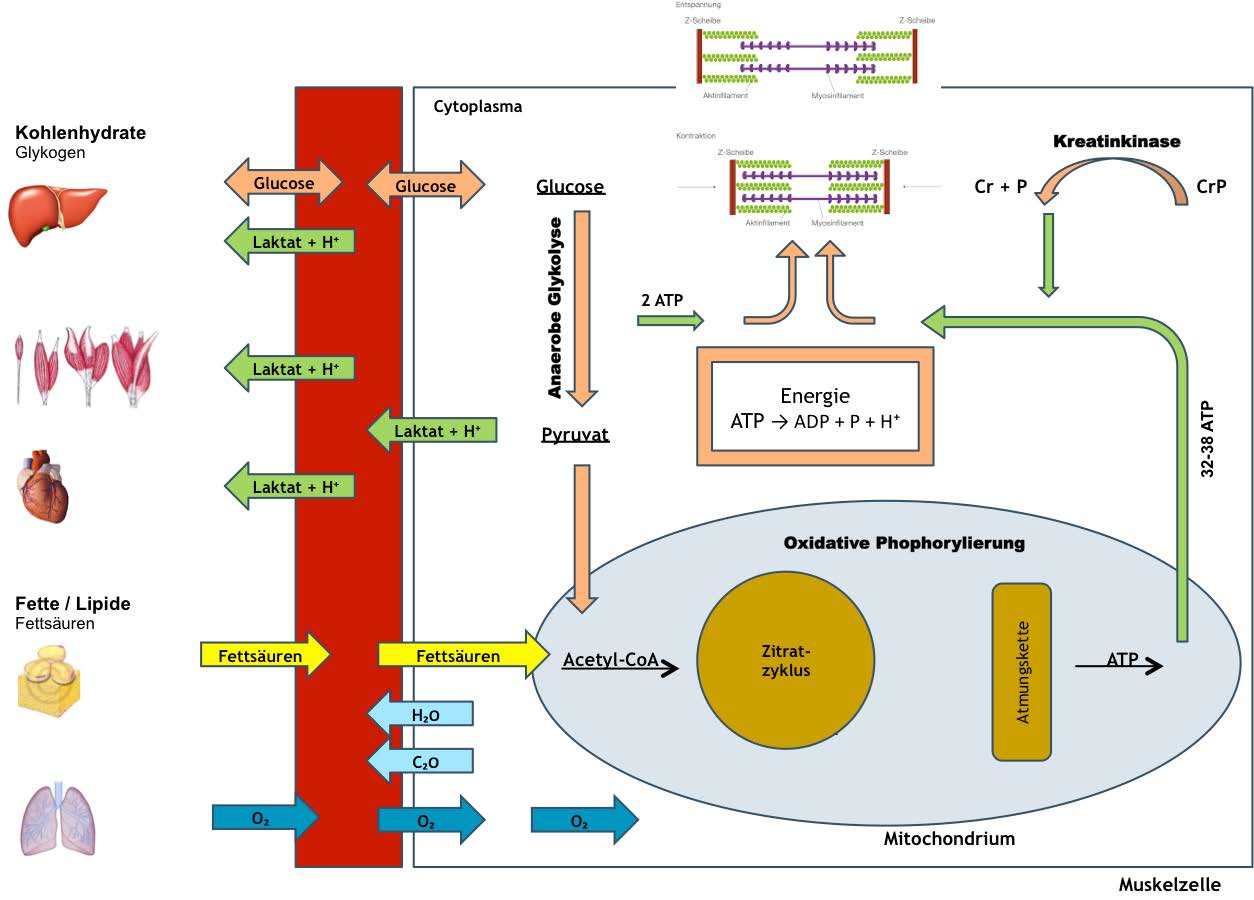
The metabolic pathways described basically run simultaneously (hybrid engine), but in different amounts. The proportions of the energy-supplying processes vary depending on the duration and intensity of the exertion. Even at rest, creatine phosphate is broken down or lactate is produced. The more intense the exertion, the higher the muscles' immediate need for energy and ATP, and the more the fast anaerobic metabolic pathways are involved. Even so, a relatively large proportion of the energy needed is still supplied aerobically during this kind of exertion.
So you can happily forget the claim that fat burning only starts after 30 minutes of endurance training.
You'll find supplements to boost your metabolism here