
Milk
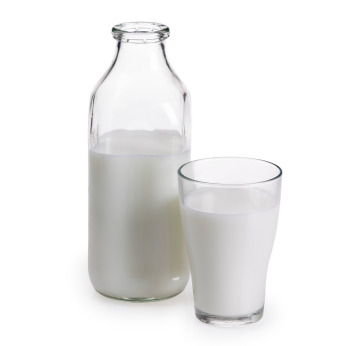
Not all milk protein is the same
In the article “What are high-quality protein sources?” I introduced the Digestible Indispensable Amino Acid Score (DIAAS) as the current standard for assessing the quality of protein sources. The DIAAS for the total milk protein fraction (cow’s milk*) is a high 122%. This makes milk one of the highest-quality protein sources of all. As already hinted, however, not all milk protein is the same, and the different milk protein fractions affect protein balance in different ways. That is why this article takes a closer look at the different milk protein fractions.
Composition of cow’s milk
Cow’s milk consists of roughly
- 87.2% water
- 4.9% milk sugar (lactose)
- 3.9% milk fat
- 3.2% milk protein (total fraction) and
- 0.8% micronutrients.
Milk protein fractions
The total protein fraction can be further divided into roughly
- 22% whey protein and
- 78% casein,
with whey protein and casein each being divisible into further sub-fractions. According to current knowledge, however, this further division has no effect on protein balance, which is why, for simplicity, I will refer to “whey protein” and “casein” from here on**. The exact division into sub-fractions, with their molecular masses (“size/weight of the protein molecules”) and isoelectric points (“pH values with the lowest solubility”), is shown in Table 1.
Table 1: Characteristics of the individual milk protein fractions according to Etzel 2004.
| Fraction | Mol. mass | Concentration | Isoel. point |
| Whey | (kg/mol) | (g/L) | (pH) |
| β-lactoglobulin | 18 | 3.2 | 5.4 |
| α-lactalbumin | 14 | 1.2 | 4.4 |
| Serum albumin | 66 | 0.4 | 5.1 |
| Immunoglobulin G | 150 | 0.7 | 5–8 |
| Lactoferrin | 77 | 0.1 | 7.9 |
| Lactoperoxidase | 78 | 0.03 | 9.6 |
| Glycomacropeptide | 8.6 | 1.5 | <3.8 |
| Casein | |||
| κ-casein | 19 | 3.3 | 5.8 |
| β-casein | 24 | 9.3 | 5.2 |
| αs-caseins | 24 | 13 | 4.9/5.3 |
Because the two fractions “whey protein” and “casein” differ in how quickly they are digested and have different amino acid profiles, they also affect protein balance differently. In the next article I will look at this point in detail and show how comparable amounts of casein, whey protein and soy protein affect muscle protein metabolism.
*In what follows, “milk” means cow’s milk and “milk protein” means cow’s milk protein.
**The various sub-fractions (e.g. immunoglobulin G) may have specific effects on the human body. Some whey protein fractions, for example, are said to have an immunomodulating effect. With regard to protein balance, however, no positive effects have been shown so far.
Links:
