
Are free weights more effective than machines for muscle growth?

Basically, it doesn't matter to your muscle whether you train it with free weights or with a machine. A muscle simply adapts to a training stimulus. The greater the muscle fatigue (provided the time under tension makes sense), the greater the anabolic response will be. Good results can be achieved with either tool, as long as certain points are observed. However, training with free weights does come with one clear disadvantage.
The biceps is a clear example of the disadvantage free weights have compared to machine training. If we let go of the dumbbell, it always falls towards the floor (gravity). This is a clear disadvantage, because it means the load always acts in the same direction, namely towards the floor. The forearm, however, rotates around the elbow joint.
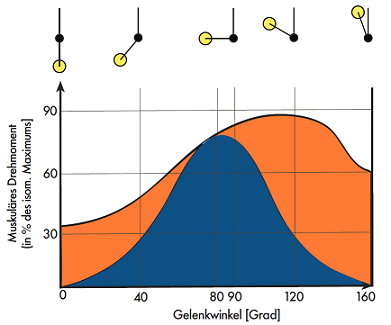
Figure 1: Muscular torque as a function of the joint angle, e.g. for the dumbbell exercise "forearm flexion at the elbow joint" ("biceps curl").
Figure 1 shows the muscular torque as a function of joint angle for the dumbbell exercise "forearm flexion at the elbow joint" ("biceps curl"). The blue area shows the muscle's force potential that is actually used. The orange area shows the force potential that isn't used. This unused potential exists because the dumbbell only offers linear resistance, while the forearm rotates around the elbow joint. Machines with a cam compensate for this disadvantage, as they're able to produce direct, variable rotational resistance. This means the muscle's force potential can be optimally exploited at every joint angle.
Figure 2: Comparison of the extension torque in free-weight biceps training with the extension torque in machine-based biceps training. (Gottlob 2011)
As you can see in Figure 2, the extension torque in the free-weight exercise is close to 0 when the arm is almost fully extended. When training on a machine, the resistance still acts on the biceps even with the arm extended.
In this case, it would make sense to choose the Iso Contraction training variant for the dumbbell exercise, since the resistance stays constant during a static contraction.
Here are the further advantages and disadvantages of dumbbells and machines
| Advantages of dumbbellsSmall weight incrementsPromotes intermuscular coordinationStabilising muscles are trainedImproves balanceMany exercise variations | Disadvantages of dumbbellsRisk of incorrect technique is highOffer no variable resistance |
| Advantages of machinesThe load curve is calculatedThe risk of injury is practically zeroMuscle isolation is guaranteedThe resistance can be adjusted effortlessly | Disadvantages of machinesStabilising muscles are only trained to a small extentThe number of exercises is limitedIntermuscular coordination is only slightly improved |
If you build less muscle than you'd like, it's hardly ever down to the machine :-).
Glossary
Cam
A cam, usually found on a single-joint machine, is an oval disc that ensures the force needed to overcome the resistance is always different, due to the uneven shape of the cam disc.
Source: Theorie Kraft, Scientifics AG
