
Fats / Lipids

General information
Fats are also called lipids. With an energy density of 38 kJ/g (= 9 kcal/g), fat is the body's most important energy supplier and carrier. Like carbohydrates, fats are made up of the elemental building blocks carbon (C), hydrogen (H) and oxygen (O); unlike proteins, they contain no nitrogen (N). Dietary fats consist primarily of triacylglycerols and cholesterol. Fats are not water-soluble. Triacylglycerols make up most dietary fats and consist of glycerol, a trihydric alcohol, and fatty acids, with three fatty acids attached to one glycerol molecule by esterification. They are the storage fat that fills the body's fat depots and can also be seen in vegetable oil or on pieces of meat.
Each of these fats is characterised by a different fatty acid composition. Fatty acids are organic acids (hydrocarbon compounds) that can be divided into short-, medium- and long-chain fatty acids according to the length of the carbon chain. They are also classified, according to the number of double bonds in the fatty acid chain, into saturated fatty acids, which have no double bond (e.g. stearic acid, palmitic acid), and mono- or polyunsaturated fatty acids with one (e.g. oleic acid) or more (e.g. linoleic acid) double bonds. As the number of double bonds increases, the substance's reactivity increases, since not all bonding possibilities are used.
This is also why fats with a high proportion of reactive unsaturated fatty acids spoil more quickly (turn "rancid"). Saturated fatty acids are also supplied to the body through food or produced by the body itself. They normally move quickly into the fat depot. With an increased intake of fat (saturated fatty acids), blood lipid levels worsen and the risk of vascular disease and type II diabetes increases. Trans fatty acids have an even greater negative potential than saturated fatty acids. Mono- and polyunsaturated fatty acids are also stored in the fat depot, but are considered easier to mobilise as part of fat loss.
Monounsaturated fatty acids are also stored in the fat depot, whereas polyunsaturated fatty acids are not.
Essential fatty acids
Some of the polyunsaturated fatty acids, such as linoleic acid and eicosapentaenoic acid (EPA) and docosahexaenoic acid (DHA), or their precursor alpha-linolenic acid, cannot be synthesised by the human body itself and must therefore be supplied through food. This is why they are called essential fatty acids.
The body is able to synthesise so-called tissue hormones (eicosanoids) from these fatty acids. These are mediators with a wide range of effects, including on blood pressure, hormone balance, inflammatory processes, the immune system, blood platelet clumping and circulation, as well as acting as mediators of certain hormone effects ("second messenger").
Sources
Important sources of fat include oils, milk and dairy products, butter, margarine, meat products and foods with so-called hidden fat, such as sweets. The fat content of (muscle) meat, on the other hand, is low, and apart from the visible fat it contains hardly any fat.
It doesn't make sense to judge fats and fatty acids by their plant or animal origin; determining the type of fatty acid is far more decisive. The reason: while fats of animal origin usually contain mainly saturated and monounsaturated fatty acids, certain plants, as well as fish, contain large proportions of polyunsaturated fatty acids. Fats can also be distinguished by their physical state: liquid (e.g. oils), semi-solid (e.g. butter, lard) and solid fats (e.g. kernel fat, tallow). As a general rule: liquid fats have a high proportion of short-chain and unsaturated fatty acids, while solid fats have a high proportion of long-chain and saturated fatty acids. Finally, in terms of processing, a distinction can be made between natural dietary fats, such as cold-pressed oils from thistles or olives, and processed dietary fats. The latter include refined fats such as cooking oil or hardened fats such as peanut or coconut fat.
Cholesterol serves as a building material for cell walls, the nervous system and hormones. When skin exposure to sunlight is high, vitamin D is formed from cholesterol. According to current scientific understanding, the influence of dietary cholesterol on blood lipids and cholesterol is considered not very strong. An excessive intake of saturated and trans fatty acids has a far greater negative influence. Cholesterol is found almost exclusively in animal foods. A daily intake of under 300 mg is recommended.
Digestion, absorption and functions in the body
In large quantities, triacylglycerols are only digested in the small intestine. There, they are broken down by enzymes from the pancreas until, finally, individual fatty acids and remaining fat components are ready for absorption. Long-chain fatty acids and free dietary cholesterol, on the other hand, are absorbed into the intestinal cells with the help of bile acids. There, triacylglycerols are reassembled from the individual fragments, which are then packaged together with cholesterol as so-called lipoproteins, released into the blood via the lymphatic system, and finally transported to the liver. To enable the water-insoluble fats to be transported in the blood, they must be packaged in a water-soluble protein coating.
In the body, fatty acids and fat perform many tasks. The best known is as an energy reserve in fatty tissue, or as an energy supplier. Compared with carbohydrates, fats can be stored in unlimited amounts. The fat-soluble vitamins A, D, E and K are also contained in fat, as are flavour and aroma substances, which are often fat-soluble. Hence the great popularity of foods made from fat.
- Depot fat serves as a store and is constantly being broken down and rebuilt. Depot fat also has gland-like functions, meaning that, depending on how full they are, fat cells produce signalling and messenger substances (adipokines such as leptin) that affect metabolism. If the body's fat percentage is high, the increased release of adipokines can be expected to have unfavourable effects, such as an increased tendency to inflammation and high insulin levels.
- Organ fat, on the other hand, serves to cushion and fix the organs in place.
- Every cell wall in our body contains fatty acids, which also perform countless functions in energy and immune metabolism.
Overview of the occurrence and function of fats in the human body:
- In white adipose tissue: depot or storage fat as well as essential structural fat (e.g. brain, kidney bed)
- In so-called brown adipose tissue (only a small proportion, usually located between the shoulder blades and near the aorta in the chest): thermoregulation
- Mechanical protection of organs, e.g. kidney fat
- Skin protection against external influences
- Vehicle for the absorption of fat-soluble vitamins (A, D, E, K, provitamin carotene) as well as aroma and flavour substances
- Source of, among others, essential fatty acids needed for building cells and cell membranes and for various metabolic processes. They control the resorption (absorption) of fats from the intestine, regulate fat metabolism and help lower elevated cholesterol levels.
Intake
A healthy adult should consume about 1 g of fat per kg of body mass (BM) per day to ensure sufficient intake of vital essential fatty acids. No fat intake over a longer period leads to life-threatening complications. For physically active people, daily fat intake should be 1 to 3 g per kg BM, and can be even higher during extreme endurance exertion.
About 10% of total energy intake comes from long-chain saturated fatty acids plus trans fatty acids (about a third of fat intake), about 7% from polyunsaturated fatty acids (with a ratio of n-6 to n-3 fatty acids of no more than 5 to 1), and the remaining 10 to 15% from monounsaturated fatty acids.
To follow the recommendations on fatty acids, it's simple and sensible to follow the nutrition pyramid.
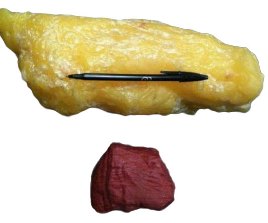
About 2 kg of fat compared with an equal 2 kg of muscle mass.
