
Does easy endurance training really ‘burn’ more fat?

Everyone wants to burn fat. But how you do that best is the key question here.
You often hear that fat only starts being burned after half an hour of moderate endurance training. However, a quick look at the intermediary metabolism from an exercise physiology perspective gives us a deeper insight into how the body supplies energy. It's true that after around half an hour of ‘easy endurance training’, the percentage share of lipids (fats) rises higher than the share of carbohydrates needed.
But careful: this is only about the percentage share, not the actual amount!
As effort increases, proportionally more glucose or glycogen is burned. The actual amount of fat burned also increases, up to a maximum, before it drops again. This maximum lies at around 65% VO2max. At this intensity, trained individuals can burn an average of 0.6g of fat per minute. At 65% VO2max, the relative share of fat burning is about 50%, at 20% VO2max it would be almost 100% (see graphic).
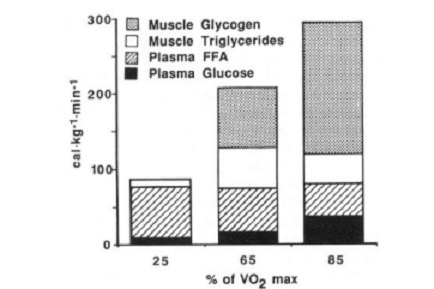
In other words: at low intensity, the relative share of fat burning is indeed much higher, but what matters for burning as much fat as possible is not the relative share, but the absolute amount.
So if the overall exertion is higher, absolute fat consumption is higher too, and ultimately what matters most is the total amount of energy used (kcal).
Endurance athletes aim for a balanced energy balance and try to burn as much fat as possible to save valuable glycogen. Without glucose or glycogen, running pace has to be halved! When the goal is weight loss, the situation looks completely different. Here, a negative energy balance is needed, meaning energy expenditure should be higher than energy intake. Logically, that can be achieved either by reducing energy intake or by increasing energy expenditure.
A combination of both effects is by far the most successful approach for weight loss.
