
Which protein powder should I buy?
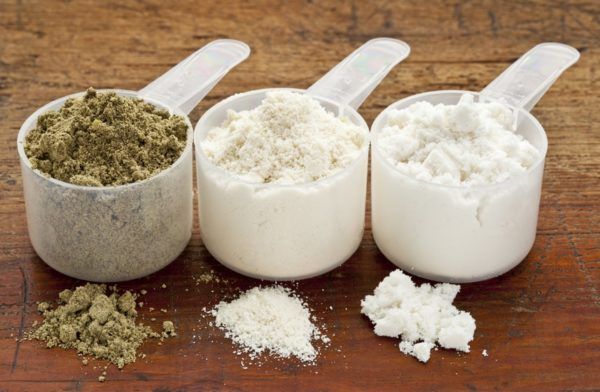
You want to buy a protein powder, but you don't know which powder is best suited for you.
We'll help you and give you an overview of the jungle of protein powders. You will then surely find the right protein.
There are already a great many protein types on the market. To get the maximum effect from the powder, you need to make sure that the quality of the protein source is as high as possible and that the timing is right. As a rule, 20 g of high-quality protein every 3 to 4 hours is sufficient. You can get this, for example, from approx. 100 g of chicken, approx. 65 g of beef or 22 g of high-quality whey protein isolate. Whey protein is nothing other than whey protein.
Which protein powders are available on the market?
The best-known protein sources are probably animal protein powders such as whey protein (milk protein) or casein protein. These two sources are contained in milk, namely whey protein (20%) and casein protein (80%).
Plant-based protein sources are also very much in trend. Here you can find, for example, soy protein, rice protein, pea protein, hemp protein etc.
By far the most suitable plant-based source for building muscle is soy protein.
Advantages and disadvantages of the individual protein powders
Whey protein
Whey protein (milk protein) is a natural, very high-quality dairy product that settles on the surface during cheese production after the curd (casein) has been skimmed off. Through special filtration methods, this whey is concentrated and
processed into powder. You can buy whey protein in three forms: concentrate, isolate and hydrolysate.
Whey protein concentrate
Using ultrafiltration technology (membrane filters), whey protein concentrate achieves a protein content of between 70 and 80%, a fat content between 3 and 5% and a reduced lactose content. Pure whey protein concentrate contains approx. 20 g of protein per 25 g of powder.
Whey protein isolate
Whey protein isolate has a protein content of 90 to 96% and a fat and lactose content of under 1%. With whey protein isolate, a distinction is made between CFM whey isolate (cross-flow microfiltration) and normal whey isolate (ion exchange). Whey hydrolysate is nothing other than protein that has been enzymatically broken down into shorter peptide chains. Whey hydrolysate is very expensive and offers no greater benefit than whey protein concentrate or whey protein isolate. Pure whey protein isolate contains approx. 20 g of protein per 22 g of powder.
Whey protein concentrate is slightly cheaper than whey protein isolate, but its protein content is slightly lower. This has hardly any effect on the results. It therefore doesn't matter whether you consume whey concentrate or whey protein isolate after training, unless you suffer from lactose intolerance. In that case, whey protein isolate would be better suited for you.
Casein protein
Casein protein is, alongside whey protein, the main component of milk protein. Casein protein makes up 80% of it. Casein. With casein, the protein is absorbed more slowly, but it leads to a long-lasting increase in the amino acid concentration in the blood.
Egg protein
Egg protein is particularly low in carbohydrates and fat. It is often used especially during dieting phases.
Many people mix egg protein into their whey shake to improve the amino acid profile. A further advantage of egg protein is that it is free of milk sugar (lactose) and milk protein. People with lactose intolerance or milk protein allergy often have difficulty finding a protein they can tolerate.
Soy protein
Soy protein is ideal for a low-carbohydrate and low-fat diet. It is particularly suitable for people with cow's milk allergy or lactose intolerance, vegetarians and vegans.
For people with lactose intolerance, a vegan soy protein is a very well-tolerated substitute for whey or casein protein powder. Soy protein is also rich in micronutrients, for example B vitamins. Minerals such as magnesium and potassium (important for muscle function) and trace elements such as iron (which ensures oxygen transport in the blood) are also present in relatively large amounts.
Which protein powder has the greatest effect on building muscle?
First of all: the trigger for building muscle is regular muscle training. Unfortunately, you can't simply eat your way to muscle.
Scientific studies show that the muscle protein synthesis rate is higher when whey protein is consumed than with soy protein or casein protein. For an optimal effect, take one portion of approx. 20 g of protein every 3 to 4 hours (higher amounts do not have a greater effect). Drink whey protein isolate with water rather than milk. Milk unnecessarily delays the absorption of whey protein.
Directly after training, use whey protein if possible to cover your protein requirements.
Thanks to its slow absorption, casein protein provides a constant amino acid level in the blood over several hours. It is therefore ideally suited for protein supply before going to sleep.
Even though soy protein is not the first choice for increasing the muscle protein synthesis rate, it still has considerable advantages. For example, it is very well suited for people with lactose intolerance as well as for people with a milk allergy. Soy protein is therefore a very well-tolerated substitute for whey or casein protein powder.
Egg protein would be the animal alternative if you suffer from lactose intolerance or milk protein allergy.
