
The Three-Component Model of Endurance Performance

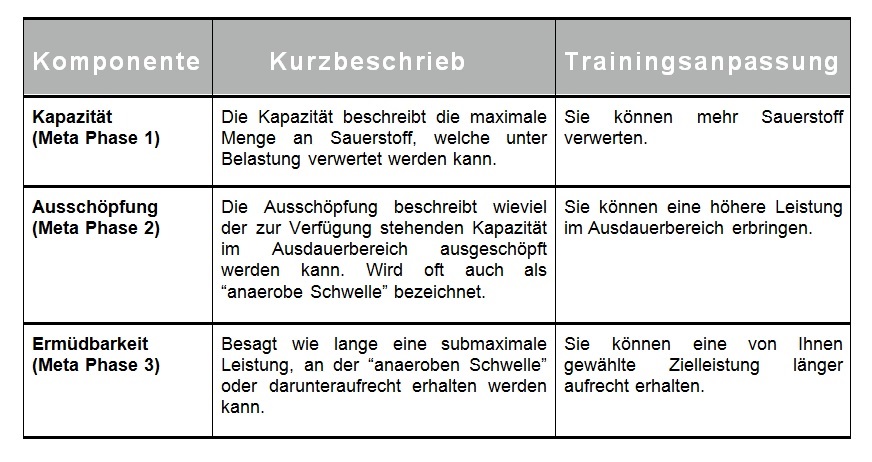
Endurance training is based on the three-component model of endurance performance (capacity, utilisation and fatigability). Although the components of endurance performance and their underlying factors cannot be trained in isolation, it is the type of training that determines the training adaptations. High-intensity interval training increases capacity and thereby also improves the general performance level. Utilisation is likewise trained with intervals in the high-intensity range. Here, the duration of the intervals (load phases) is increased compared with capacity training, while the intensity and the duration of the recovery phases are reduced. Fatigability is reduced by maintaining a set, constant output over a longer period of time.
Capacity (Meta Training Phase 1)
Capacity refers to the maximum amount of oxygen the human body is able to utilise (VO2max). Oxygen is absorbed from the ambient air into the blood in the lungs. The oxygen-rich blood then supplies all organs, such as the muscles, with oxygen via the cardiovascular system. Blood flow in the cardiovascular system is determined by the heart's pumping capacity. This results from the heart rate and the stroke volume (the volume of blood ejected by a single heartbeat). In the skeletal muscle, the oxygen is taken up into the muscle cell for energy production. VO2max is primarily limited by the heart's pumping capacity. Accordingly, regular endurance training leads to an enlargement of the heart's volume (athlete's heart). This increases the stroke volume (from 70 ml up to 150 ml), which lowers the heart rate during submaximal exertion and at rest (a lower resting heart rate).
Utilisation (Meta Training Phase 2)
Utilisation indicates the load that can just still be sustained as an endurance performance (at least 20 min). It therefore determines how far capacity can be utilised in the endurance range. It is also often referred to as the “anaerobic threshold”. The better the aerobic energy supply is developed, the higher the utilisation. An improvement in utilisation is expressed by the fact that higher intensities can be achieved in the endurance range.
Fatigability (Meta Training Phase 3)
Fatigability indicates how long an endurance performance can be sustained. Various factors play an important role here:
Efficient thermoregulation prevents body temperature from rising too much during training and limiting performance.
- The larger the glycogen stores in the muscles, the longer intense endurance efforts can be sustained.
- The better the respiratory muscles are trained, the less quickly they fatigue during intense endurance efforts.
- Mental aspects also play a decisive role in how long fatigue can be delayed during an endurance effort.
The training adaptations in all the points mentioned extend the duration for which a submaximal performance can be sustained.
Source: Meta Training, update Fitness AG
