
The Skeletal Muscle System

The human body contains around 650 skeletal muscles.
Most muscles connect 2 or more bones and cross a corresponding number of joints. They're named accordingly: single-joint, two-joint or multi-joint muscles.
Every muscle has an origin and an insertion, made up of the muscle head and the muscle belly. Some muscles have several origins, and therefore several heads, which is why they're called two-headed, three-headed or multi-headed. The origin lies in the trunk area or in the part of a limb closest to the trunk. The insertion is further from the trunk.
Besides being named by heads and joints, muscles are also classified by their shape and fibre arrangement. A distinction is made between spindle-shaped, pennate and flat muscles. Most commonly, muscles are named after their function and location. Muscles that bend a joint are called flexors, those that straighten it are called extensors.
Types of contraction
A muscle can change its length through contraction (shortening) or dilation (stretching). Dilation is usually brought about by the antagonist (the opposing muscle). The muscle that carries out the actual movement is called the agonist. When two muscles support each other's effect, they're called synergists.
Depending on the change in force or length of the muscle, different types of contraction can be distinguished:
- Isotonic: The muscle shortens without a change in force. The tone (tension) stays constant.
- Isometric: The force increases while the muscle length stays the same (static holding).
- Auxotonic: Both force and length change. This is the most common type of contraction in everyday movements.
Based on the resulting change in muscle length, contractions are further divided as follows:
- Isokinetic: The resistance is overcome at a constant speed.
- Concentric: The muscle overcomes the resistance and shortens as a result. The intramuscular tension changes, and the muscles shorten.
- Eccentric: The resistance is greater than the tension in the muscle, so the muscle is stretched. The muscle is stretched despite being under tension.
Structure of skeletal muscle
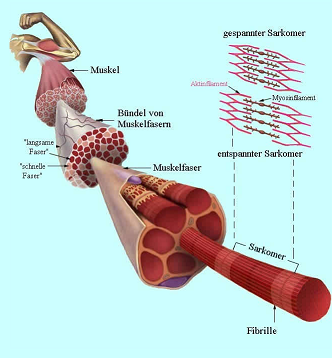
Every skeletal muscle has the same structure, no matter how long it is or what shape it has.
Every muscle is made up of a bundle of muscle fibres. A single muscle fibre (muscle cell) is surrounded by capillaries, which ensures the blood supply. A muscle fibre in turn consists of so-called fibrils (myofibrils). Each fibre is made up of several myofibrils. A fibril consists of several sarcomeres. Each sarcomere consists of myofilaments. There are three myofilaments: actin filaments, myosin filaments and titin filaments. The myosin filaments are the thickest, the actin filaments are thinner. The different diameters of the actin and myosin filaments give skeletal muscle its striated appearance.
A sarcomere is the distance from one Z-disc to the next. The Z-discs each mark the end of the actin filaments. The myosin filaments lie between the actin filaments. The myosin filament is connected to the Z-disc by the titin filament.
Muscle contraction
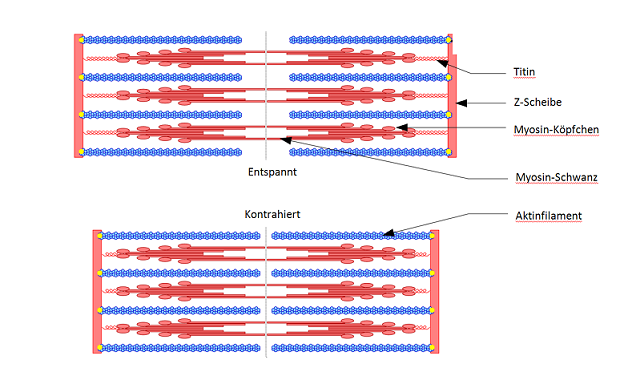
During contraction, the position of the filaments changes. When the muscle contracts, the myosin heads bind to the actin filament and
pull towards the Z-disc. The actin and myosin filaments themselves are not shortened during muscle contraction. Releasing the myosin head requires energy in the form of ATP (adenosine triphosphate). This is what allows the muscle to shorten. When no more ATP is available, this triggers a cramp.
The command for the contraction is triggered by a nerve stimulus (impulse). A single nerve impulse only produces a single twitch. When many stimuli arrive one after another, this leads to many contractions and thus to a (visible from the outside) muscle contraction.
Muscle fibre types
In humans, muscles are divided into three fibre types: type 1, type 2A and type 2X. Every person has all three fibre types. Type 1 fibres are slow-twitch fibres with low fatigability. Energy is mostly produced aerobically. Myoglobin (the red muscle pigment) is responsible for oxygen transport in the muscle cell (similar to haemoglobin in the blood). Type 1 fibres contain more myoglobin than type 2 fibres. They also have a high number of mitochondria. Type 2 fibres are fast-twitch fibres and work more anaerobically. These fibres fatigue faster than type 1 fibres. They're divided into the 2A and 2X groups. The 2X fibres are the ones that twitch quickly and fatigue quickly, while the 2A fibres are also fast-twitch fibres but fatigue less quickly.
Strength or endurance training causes a shift in muscle fibre composition. This shift runs from 2X fibres to 2A fibres.
Our muscles always show a mix of the different fibre types. On average, we have around 40% type 1 fibres and 60% type 2 fibres. The exact composition is genetically determined, which is also why certain sports suit a particular "type" better than others.
Muscle and training
When a muscle is exposed to a greater load than usual, it adapts. The muscle stores more protein and thereby increases in volume. This is known as hypertrophy (the opposite is atrophy, a decrease), the increase in the size of muscle fibres (i.e. an increase in the cross-sectional area of the myofibrils). Hyperplasia is the physiological increase in muscle cross-section due to an increase in the number of muscle fibres (this has not yet been proven in humans).
Longitudinal growth (growth in length): an increase in the length of individual muscle fibres while the cross-section stays the same. Muscles can adapt to a new functional length by adding new sarcomeres in series at the ends of the myofibrils.
The muscle doesn't only adapt to strength training, though, but also to endurance training. Changes occur primarily in the muscle's energy supply: the number of mitochondria increases, the muscle's capillarisation increases, the muscle's energy system works better, and the energy reserves in the muscle can be used more quickly.
Intensive training can cause muscle soreness. Muscle soreness occurs more often with unfamiliar and intense movements (usually eccentric, i.e. braking), which leads to overstretching of parts of the cell and to small tears and deformations in the muscle. These micro-tears cause a build-up of fluid in the muscle fibres. This build-up, together with the repair processes, irritates the pain nerves - that's what causes muscle soreness. Light massages, gentle movement or warm baths can help relieve the pain. Intensive training is not recommended, since this is in fact an injury to the muscle.
