
The Force-Length Relationship (the "Strength Curve")
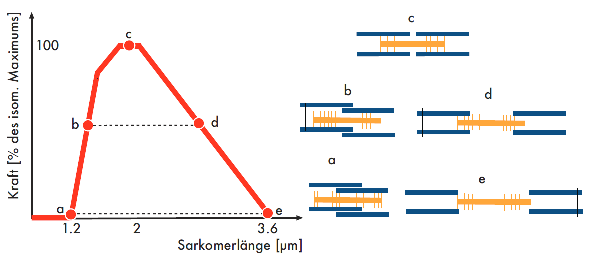
Image description: force-length relation (Gordan, Huxley, Gulian, 1966)
Force-length relation of a single sarcomere. The force that can be produced depends on how many actin-myosin cross-bridges are present (how great the degree of overlap between actin and myosin filaments is).
The active force that a fibre can generate as a linear motor at a constant length (isometrically) depends on its current length. In the lengthened state, the force is smaller, because the overlap between actin and myosin is smaller, which also reduces the maximum number of bindings. In the shortened state, inhibition occurs, because the neighbouring overlap reduces cross-bridge activity.
To be fast at the muscle level, long muscle fibres (many sarcomeres in series) are certainly beneficial. Each sarcomere can shorten at the same maximum speed. When more sarcomeres are connected in series, the fibre can shorten over a greater distance in the same unit of time, and this results in a higher speed.
Sources: Theorie Kraft, Scientifics AG
