
How your heart adapts to cardio training

As already explained, regular, systematic cardiovascular training increases physical performance and causes clear adaptations in the cardiovascular system and the working muscles. The rising oxygen demand of physical work is met by a sophisticated oxygen transport system. This has several stages, with different mechanisms taking place at each one that can limit oxygen transport. Without going into too much detail here, these stages are
- the lungs, or more precisely pulmonary gas exchange,
- the heart and the blood,
- the muscle capillaries and, finally,
- the mitochondria.
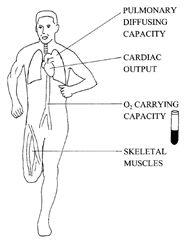
Components of oxygen uptake (Bassett and Howley 2000)
To simplify, the determinants of oxygen supply can be split into a central and a peripheral component (leaving aside the first determinant, pulmonary gas exchange, since it does not limit oxygen supply in healthy people "at sea level"). According to the law put forward by Adolf Fick as early as 1870, the central component of oxygen consumption is the heart's pumping capacity (how many litres of blood the heart pumps per minute), and the peripheral component is the arteriovenous oxygen difference (how big the difference in oxygen concentration is between arterial and venous blood, or put more simply: how much oxygen "the organ takes out of the blood").
Fick's formula reads as follows (with the abbreviations and units in brackets):
Oxygen consumption (VO2 in ml/min) = cardiac output (Q in l/min) x arteriovenous oxygen difference (avDO2 in ml/dl)
Cardiac output, in turn, is calculated as the product of stroke volume (Vs in ml) and heart rate (fH in beats per minute).
In other words: how much blood the heart ejects per heartbeat x how often the heart beats per minute.
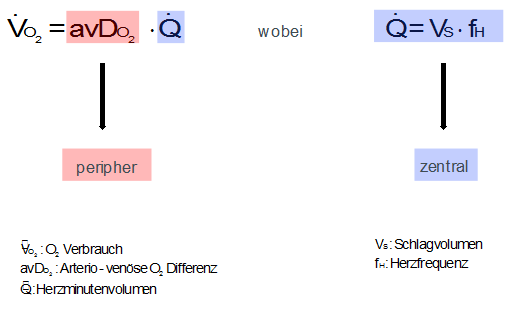
Central vs. peripheral (Fick 1870)
To sum up: the central component of oxygen consumption depends on heart rate and stroke volume, while the peripheral component depends on oxygen extraction.
Since stroke volume increases with specific training, while cardiac output (and oxygen demand) stay roughly the same at submaximal effort, we measure a lower heart rate after a training phase at the same workload. It is therefore stroke volume that increases through training (improved cardiac contraction function and a larger heart muscle). With maximum heart rate staying the same, the heart's maximum blood delivery capacity (maximum cardiac output) therefore increases. At the same time, resting heart rate drops, because the heart needs to beat less often to transport the same amount of blood, thanks to the larger stroke volume.
Endurance training improves not only the central component, though, but also the arteriovenous oxygen difference, and thus oxygen extraction from the blood. This improvement mainly comes from improved capillarisation (higher capillary volume in the tissue, e.g. more capillaries per muscle fibre) and an increased mitochondrial volume (more or larger mitochondria). In the periphery, this improves the fine distribution of oxygen as well as its use.
Interestingly, the central and peripheral components of oxygen uptake can now be trained more or less specifically. In other words, there are training methods that work the two components relatively selectively and thereby improve them. This is also the background to the earlier statement about the benefits of HIIT. To make it easier to apply these physiological facts in training, we developed the 3-component model of cardiovascular performance. It consists of the components potential, extraction and fatigue resistance, and is presented below.
Potential
Potential refers to the maximum amount of oxygen the human body is able to use (VO2max). Oxygen is taken up from the ambient air into the blood in the lungs. The oxygen-rich blood then supplies all organs with oxygen via the cardiovascular system. In the skeletal muscles, the oxygen is then taken up into the muscle cell to provide energy. Blood flow in the cardiovascular system is determined largely by the heart's pumping capacity. This results from the product of heart rate and stroke volume (the volume of blood that can be ejected by a single heartbeat). Regular, intensive interval training increases stroke volume and thus increases the heart's pumping capacity, which lowers heart rate during submaximal exertion and at rest (a lower resting heart rate). As a consequence of this adaptation, VO2max also increases.
Extraction
Extraction indicates the intensity that can still just be sustained as an endurance effort. By definition, after a 10-minute warm-up, this effort must be sustainable for 20 minutes at a "constant blood lactate concentration" (maximum lactate steady state). Extraction therefore determines how much of the potential can be used in the endurance range (%VO2max). It is also often called the "anaerobic threshold". The better developed the aerobic energy supply is (higher mitochondrial volume, better capillarisation), the higher the extraction. An improvement in extraction shows up as the ability to sustain higher intensities in the endurance range.
Fatigue resistance
Fatigue resistance defines how long any given endurance effort can be sustained (tlim). Several factors play an important role here:
- A well-trained aerobic metabolism ensures energy supply over the long term.
- Efficient thermoregulation stops body temperature rising too much during training and limiting performance.
- The larger the glycogen stores in the muscles, the longer intense endurance efforts can be sustained.
- The better trained the respiratory muscles are, the less quickly they fatigue during intense endurance efforts.
- Mental aspects also play a decisive role (how long you can delay stopping during a fatiguing endurance effort).
Adaptations in all the points mentioned, brought about through training, extend the length of time a submaximal effort can be sustained.
With Meta Training, you train these 3 performance-limiting components of endurance capacity in a targeted way. Get advice from your coach.
