
Sugar: friend or foe?
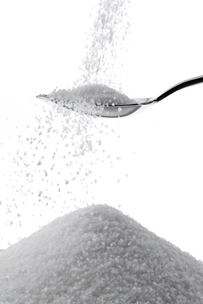
How often have you been unable to resist a delicious bar of chocolate, even though a healthy apple was there for the taking? How many times have you gone for a cold soft drink instead of a glass of water? Is a sweet tooth built in, or even innate? What positive or negative effects does eating sugary foods have on our body?
Sugar – a valuable commodity
The main sources of sugar are sugar cane, which is grown in the tropics, and, in temperate regions such as Central Europe, the sugar beet. Sucrose (table sugar or granulated sugar) is present as a substance directly in these crops and is extracted by dissolving, boiling or pressing them in an aqueous solution, then precipitated as crystals during further boiling down. The first to develop methods for extracting sugar from sugar cane were the Persians (600 BC). It was not until 1100 AD that Europeans came to know sugar, which was initially used only for medicinal purposes. For a long time sugar was an expensive commodity, and only the wealthy could afford this sweet luxury. Towards the end of the 18th century, the sugar beet was discovered as an important raw material for sugar production, leading to the opening of the world's first beet sugar factory in Silesia (a region in Central Europe). Today the world's most important sugar producers are Brazil, India and China. In Europe, France, Germany and Poland are among the leading producer countries.
«In Switzerland, sugar consumption in the year 2000 was over 50 kg per person. 50 years before that, it was just 4 kg.»
The nutrient's role
Sugar belongs to the carbohydrates, which are biologically one of the most important classes of substances. Together with fats and proteins, carbohydrates make up the largest usable (e.g. starch) and non-usable (e.g. dietary fibre) proportion of our food, by quantity. Monosaccharides form the starting point for carbohydrates. A distinction is made between monosaccharides (simple sugars, e.g. glucose, fructose) and disaccharides (double sugars, e.g. granulated sugar, lactose), both of which have a sweetish taste. Polysaccharides (complex sugars, e.g. starch, chitin), on the other hand, are flavourless. The main role of carbohydrates, and therefore of sugar, is to supply energy. Just as important, the nutrient serves as a building material for human cells and as a regulator for the gut.
Honey – a high-quality sugar
Honey is more than just a sweet spread for bread. It is made up of around 78% sugar and around 18% water. The rest is made up of other constituents. Depending on its origin, the proportions of the different types of sugar vary. To keep our bodies healthy, it's not just important that individual nutrients are consumed in sufficient quantities, but also in what form they're offered to the body. Honey is not an isolated nutrient, so its chemical composition and its effect on the body differ greatly from isolated sugar. Among other things, the enzymes, minerals and vitamins contained in honey are just as important as the sugar itself.
Sugar and sport
Sugar does provide energy, but it can't supply any other nutrients. Simple sugars and sweets should therefore only be eaten in moderation. Sugar is well known for entering the bloodstream quickly, giving you a fast and usually noticeable energy boost. However, your blood sugar level drops just as fast as it shot up, which can cause a sudden energy slump, leaving you feeling weaker than before you had the sugar. So the rule is: pay attention to sugar quality and don't underestimate it. Brush your teeth after isotonic drinks – they're highly concentrated and full of sugar!
How much is right?
Consuming too much sugar can trigger a range of symptoms, including tiredness, lack of drive and energy, depression, anxiety, or stomach and gut problems. It also weakens the immune system, leaving it unable to protect the body properly. So enjoy it in moderation!
Sources: Nico Forster (COACH Magazin)
